
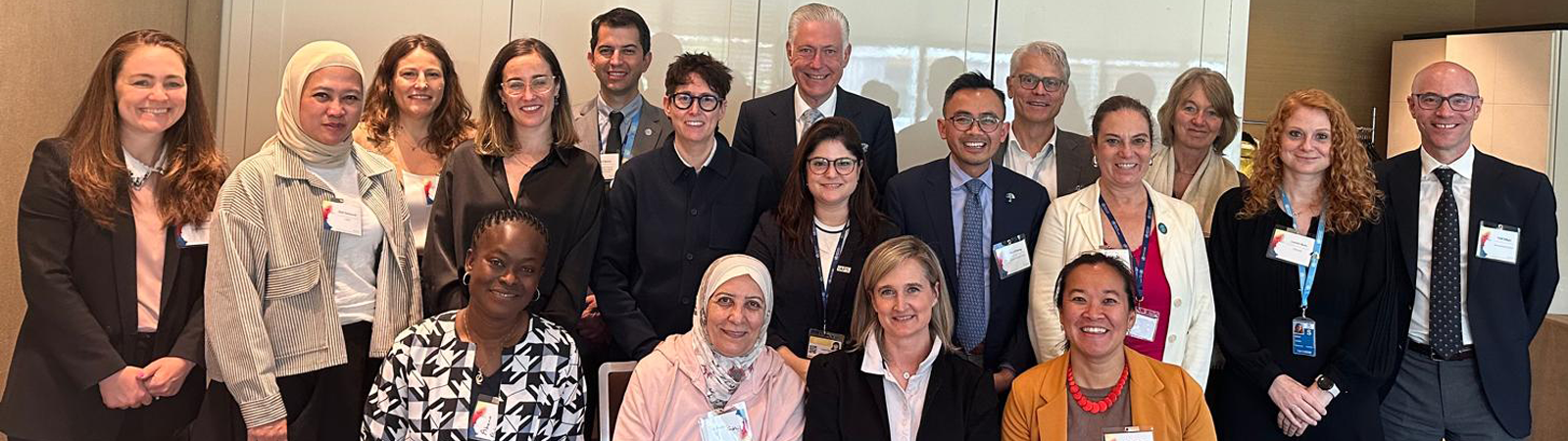
Attendees of the Lancet Global Health Commission on People-Centered Care for Universal Health Coverage: Early Insights and Policy Implications meeting
How can the Lancet Global Health Commission on People-Centered Care for Universal Health Coverage’s policy and health system-level analysis be made more useful, actionable, and sensitive to different health system realities? With that question in mind, the Commission organized a closed roundtable meeting on the sidelines of the 2026 World Health Assembly. The space for this meeting was generously sponsored by Novartis.
Attendees included Lara Bloom of The Ehlers-Danlos Society and IAPO, Laetitia Bosio of UHC2030, Kelly Butterworth of Roche, John Fogarty of WHO, Antonia Gama of IAPO, Lutz Hegemann of Novartis, Diah Saminarsih of CISDI, Marion Souveton of Roche, and Commission secretariat members David Duong, Bethany Holt, Todd Pollack, and Katie Cavender. Others attended with colleagues or on behalf of colleagues.
As the Lancet Commission entered its second year (Q2 2026), this meeting served to share our progress, early insights, and policy implications. Following our August 2025 convening, we launched a discovery phase (10/2025-8/2026) driven by seven integrated workstreams (WS):
- WS 1: Framing the Commission: Establishes the report’s introduction (Chapter 1), framing person-centered care (PCC) around the foundational concept of rebuilding trust in care systems.
- WS 2 & 3: Concept Analysis & Qualitative Research: Triangulates literature reviews with global, in-depth interviews capturing the lived experiences of patients, providers, and managers.
- WS 4: Scoping Review: Analyzes peer-reviewed and grey literature on PCC interventions, measurements, and outcomes at the delivery level.
- WS 5: Policy Analysis & Translation: Uses policy analysis, interviews, and surveys with policy stakeholders to evaluate translation pathways. This workstream aims to build on the insights gathered from interviews and the literature to understand the systems enablers and barriers affecting the operationalization and implementation of PCC. It also aims to create accountability structures as health systems of varying contexts aim to start or sustain their commitment to PCC. This meeting focused on this workstream's approach and findings.
- WS 6: Continuous Engagement: Integrates ongoing guidance from our Lived Experience Advisory Forum (LEAF) and Indigenous Advisory Group (IAG).
- WS 7: Advocacy & Dissemination: Drives strategic planning to share findings at professional events, identify advocacy opportunities for commissioners, and socialize our PCC framework with a wider audience.
Key discussion themes
Framing people-centered care
We initiated the discussion by addressing the crisis of trust in healthcare, presenting global and cultural evidence on the historical meaning of "care" to contrast it with today's contemporary, cure-focused systems. Participants broadly agreed that the current framing around people-centered care is compelling. Still, several urged more granularity in the analysis, clearer distinctions between access and availability, and stronger attention to implementation, accountability, and lived experience. Framing PCC around trust resonated with the group, highlighting that effective coverage should be distinguished from mere availability, and the analysis should show how it builds on existing efforts.
Policy scoring methodology
The policy analysis was presented for feedback. This work aims to evaluate national health strategic plans from WHO member states to understand their level of commitment to people-centered care. The appropriate methodology for doing this was a major thread running throughout the conversation. As end users of the outputs of the policy analysis, the participants in the discussion gave feedback on how to make the research impactful at the highest levels. The group agreed that outputs need to be useful and intuitive to policymakers and leaders to have a meaningful impact. Several participants suggested the Commission distinguish between intention, implementation, and impact in scoring. Others suggested expanding the scoring framework to capture more nuance, such as the degree of funding, target-setting, monitoring capacity, and implementation progress towards goals of people-centered care.
Understanding people-centered care in its context
Participants also emphasized that people-centered care (PCC) must be understood in context. Voices from civil society and global health organizations stressed that in many settings, people are still struggling to access basic care, so PCC analysis should not assume a fully functioning system. The discussion highlighted the importance of recognizing intersectional barriers, including race, gender, sexuality, geography, poverty, disability, and age transitions, all of which shape whether people can access and receive the care they need.
Implementation-oriented policy analysis
There was strong interest in making the policy analysis more implementation-oriented. Participants suggested that the Commission should look not only at whether PCC appears in national or global strategies, but also at whether policies include operational detail, measurable targets, and mechanisms for accountability. Several noted that declarations of intent are not the same as real commitment, and that the analysis should distinguish between access, effective coverage, and service availability.
Drawing on existing efforts
Participants noted that reviewing strategic documents alone could not tell the full story of whether a country was truly committed to PCC, and whether documented prioritization means there is actual impact on the ground. Some contributors recommended drawing on existing efforts and frameworks to complement the work. In particular, UHC and PHC tracking approaches, WHO quality frameworks, and monitoring dashboards were cited as useful reference points. Participants also noted that interviews and self-reported policy data are valuable as lived experience and self-reporting, and should be triangulated with other methods and, where possible, supply-side perspectives.
Accountability for action
Another important discussion concerned accountability across governments, civil society, donors, industry, and other service providers. Many agreed that governments remain the non-negotiable anchor for regulation, norm-setting, and ultimate responsibility, but that other actors also play major roles in delivering care and shaping access. Some participants cautioned against a framework that lets governments off the hook, while others argued that ranking NGOs and other non-state actors in the same way as states may be unfair or misleading.
The group converged on the idea that different actors should be assessed according to their roles and responsibilities. In this view, the value of the analysis lies less in simplistic ranking and more in revealing discrepancies, clarifying expectations, and identifying where different systems are aligned or falling short. Participants also saw value in using the findings to encourage alignment among governments, donors, private sector actors, and civil society around a stronger people-centered care agenda.
Next steps
The roundtable made clear that the Commission’s work is generating serious interest, but also that its policy outputs will need to be precise about purpose and audience. Before going deeper into scoring or categorization, participants urged the team to be explicit about the outcome being sought, whether that is policy pressure, learning, advocacy, implementation guidance, or system reform.
Moving forward, the commission aims to build strong momentum for practical dissemination, including integrating its findings into multilateral and country position papers, engaging with the United Nations High-Level Meeting on Universal Health Coverage preparations and identifying “champion” member states and local government examples to feature in future advocacy.