
People-Centered Care Working Definition
People-centredness is an approach to providing the continuum of care that incorporates the needs, values, and preferences of individuals in the context of their communities. It promotes respectful, empathetic, dignified and collaborative relationships between persons and all those who contribute to healthcare, ensuring that care is not only clinically effective but also emotionally supportive and trustworthy. People-centred care is a foundation for implementing the right to health and to achieving wellbeing outcomes, and a good care experience. It is achievable when there is a shift to collaborative and co-created health and care systems.
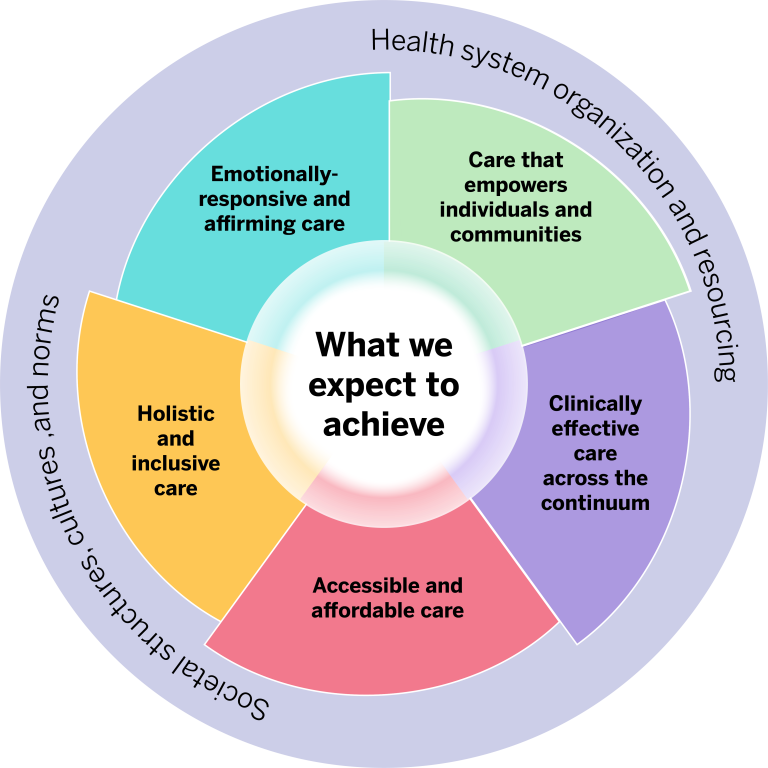
People-Centered Care Antecedents, and Consequences
Antecedents
Conditions needed for people-centred healthcare to be enacted
- Health system: Integrated health systems that are adequately resourced, managed and organized around people's' needs, cultures and contexts, and are underpinned by a commitment to staff training, education, and positive safe working conditions.
Societal factors: Social governance and community structures, cultures and norms that promote equity, social participation, accountability and culturally-safe practices, to address structural and social determinants of health and well-being
Characteristics
The defining features of people-centred care that distinguishes it from other modes of healthcare delivery
Clinically effective care that ensures technical, evidence-based quality of prevention, promotion, diagnosis, treatment, rehabilitation, and palliation across the continuum of care
Care that empowers individuals and communities to meaningfully participate in health promoting behaviours, individual care, and service/system design
Emotionally-responsive and affirming care mediated through respectful, trustworthy, compassionate, collaborative relationships with providers, families, and the care team
Holistic and inclusive care that promotes wellness, is safe, responds to diverse personal and community preferences, culture,s and contexts, including the SDoH, and is rooted in lived experiences
Care that is easy to access, affordable, and which maximises continuity of experience, as well as health system efficiency, utilisation, and effectiveness
Consequences
What we expect to achieve when people-centered care is enacted
Personal Agency & Self‑Efficacy: Growth in individuals' perceived control and capability to influence their health and care
Engagement in Care: Active participation in care processes and decisions, leading to more consistent health behaviours
Access & Continuity of Care: Improved ability to obtain services and maintain ongoing, coordinated care over time
Wellbeing: Improved physical, psychological, and social outcomes through affirming and trusting relationships
Cultural Safety & Equity: Care environments and practices that are respectful, responsive, and safe for service users and service providers
- Collective Empowerment: Communities exercising decision-making authority and influence over health priorities and services through inclusive governance.
People-Centered Care in Practice




A panel of speakers from community advocacy, clinical care, the private sector, and health system reform illustrated how people-centered care is experienced and enacted across settings.
Harry Prabowo of the Asia Pacific Network of People Living with HIV shared how stigma and disempowering clinical encounters delayed his engagement with care, while later experiences grounded in trust, shared decision-making, and emotional affirmation transformed his relationship with the health system. His story powerfully illustrated how relational quality shapes continuity of care and wellbeing.
From a provider perspective, Dr. Wipaporn Natalie Songtaweesin of the Chula Clinic reflected on the tension between aspiration and feasibility. She described how framing PCC as a guiding direction rather than a checklist allowed clinicians to pursue holistic, life-course-oriented care—beginning consultations with questions about young people’s lives, not just their diagnoses, and embedding co-design through a youth advisory board.
Logan Caragata of Roche shared a story from a colleague in Malaysia who had been deeply affected by meeting a woman at a market who had forgone breast cancer care — not because treatment was unavailable, but because she could not afford the indirect costs associated with accessing it, including lost wages, travel, and time away from family responsibilities.
In response to these realities, Roche partnered with the Government of Malaysia to pilot the decentralization of breast cancer treatment, including intravenous and subcutaneous chemotherapy, by training nurses in district facilities closer to where people live. He noted that the government has since expanded the model for breast cancer and is extending it to colorectal cancer, illustrating how people-centered service delivery innovations can be embedded within mainstream systems when they align with policy priorities and system constraints.
Finally, Diah Satyani Saminarsih of CISDI situated people-centered care within the broader challenges of implementing primary health care reform in Indonesia. Her reflections underscored that institutionalizing people-centered care requires system-level reform—addressing workforce distribution, governance, and meaningful community engagement, not just service delivery tweaks.
What Enables—or Undermines—People-Centered Care?
Following the panel, participants engaged in facilitated discussion labs focused on lived experience, implementation, and policy translation.
Across discussions, stigma, discrimination, and institutional bias emerged as central barriers to people-centered care. Participants emphasized the importance of being treated as a person in context—spoken to directly, communicated with clearly, and supported emotionally. Time, continuity of relationships, and coordinated teams were repeatedly cited as essential, alongside honest communication about system limitations.
From an implementation perspective, participants stressed that PCC is enabled by team-based care, task-sharing, and strong roles for community-based workers who provide navigation, accompaniment, and trust-building. Physical space and infrastructure—often overlooked—were highlighted as critical determinants of dignity and safety. Technology was seen as a potential enabler when it frees up time and strengthens continuity, but a risk when it displaces human connection.
Policy-focused discussions emphasized that there is no single model of people-centered care. Instead, PCC must be adapted to context—whether through adolescent-friendly services, community-owned clinics, or decentralized delivery models. Health workforce policy emerged as a central lever, alongside financing, governance, and measurement systems that reward relational, longitudinal care rather than narrow outputs.
From Engagement to Action
Overall, the PMAC side meeting strongly affirmed the Commission’s emerging framework while sharpening priorities for refinement. Participants called for clearer, more accessible language; stronger attention to marginalized populations; and explicit recognition of broader contextual conditions shaping care.
Equally important, the session demonstrated the value of participatory engagement. The meeting set a precedent for future regional discussion labs and reinforced the Commission’s commitment to grounding global guidance in lived experience and implementation reality.
As the Commission moves forward, insights from PMAC will directly inform refinement of the definition and framework, research priorities on implementation and policy translation, and ongoing engagement with participants—closing the accountability loop that people-centered care itself demands.
We invite you to follow the Commission’s work by joining our contact list or by following our LinkedIn account.
Download the full report by clicking on the link below.
PMAC Lancet Post-Event Report
(1.32 MB)
* This Commission is generously supported by Gates Foundation, Novartis Global Health, China Medical Board, and Roche.